

Churches of Konavle: Stone Witnesses of a Borderland History
- 24 hours ago
- 5 min read
Updated: 9 hours ago
Few regions have churches that narrate community history as directly as those in Konavle. From modest grave chapels beside medieval necropolises to parish churches, each one bears the trace of some pivotal moment: the arrival of new authorities, religious conflicts[1], wartime destruction, or renewal.
Before Konavle even became part of the Republic of Dubrovnik, Christianity already had a long history here[2]. However, one must distinguish what is firmly documented from what remains oral tradition. Ancient Epidaurum, present-day Cavtat, had its own bishop as early as the 530s: the First Council of Salona (in 530; according to some sources, 533) mentions Bishop Fabricianus, and at the end of the 6th century, Bishop Florentius, whose dispute with the bishop of Salona was resolved by Pope Gregory I the Great, himself. This is attested in written, ecclesiastical sources. The town was destroyed around 615 during the Avar-Slavic devastations, and the exiled bishop and population, according to tradition, participated in the founding of Dubrovnik.
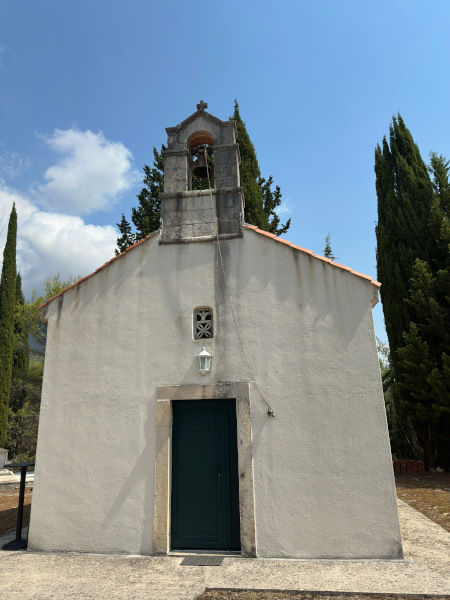
Archaeologically, however, no material remains of early Christian church architecture have yet been found in Cavtat itself. The earliest material trace of church architecture in Konavle is found in the stone tranzena (a pierced stone lattice that once closed a window opening) at the Church of St. Paul in Palje Brdo. Today it is embedded as spolia — a reused building element, outside its original context. The church itself is younger, but according to archaeological literature[3],[4] the tranzena dates to the end of the 8th century.
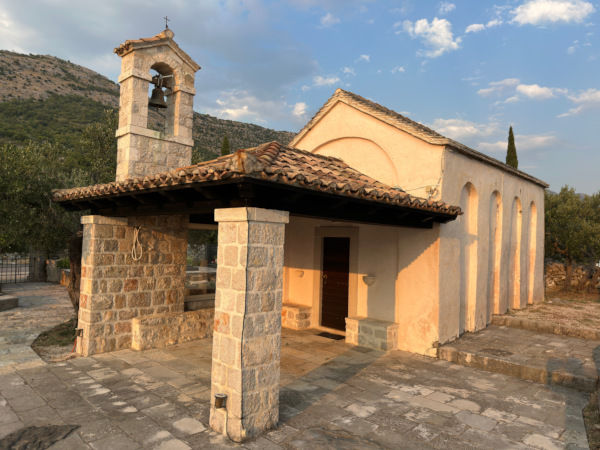
A more substantial building from the early Christian period is found in the Church of St. Demetrius in Gabrili, an Old Croatian pre-Romanesque structure from the 11th century[5]. Beside it stands a stećak necropolis, and on the stone stoup a relief Greek cross with early Romanesque stylistic features is carved. This is one of the rare places in Konavle where archaeology, not just oral tradition, confirms that a church is indeed this old.

A somewhat different story lies behind the Church of St. Barbara above Dubravka (Mrcine). The current chapel dates only from 1889, but it stands on the site of an older church[6]. Around it extends the largest and best-preserved medieval cemetery in Konavle, with 104 stećci [7] dated to the 14th and 15th centuries. This site was inscribed on the UNESCO World Heritage List in 2016.
A turning point in Konavle's religious history occurred in the 15th century, after Konavle came into the possession of the Republic of Dubrovnik. The population there was religiously mixed, so in 1429 the Republic decided to build the Franciscan Monastery of St. Blaise in Pridvorje, described as the greatest building undertaking in Konavle's history up to that time. As a result of frequent changes of supreme authority, Catholicism, Orthodoxy, and the Bosnian Church were all present in Konavle before 1419. With the construction of the monastery and church at the center of Konavle, right next to the Rector's residence, and through active evangelization, a centralization of the church structure took place.
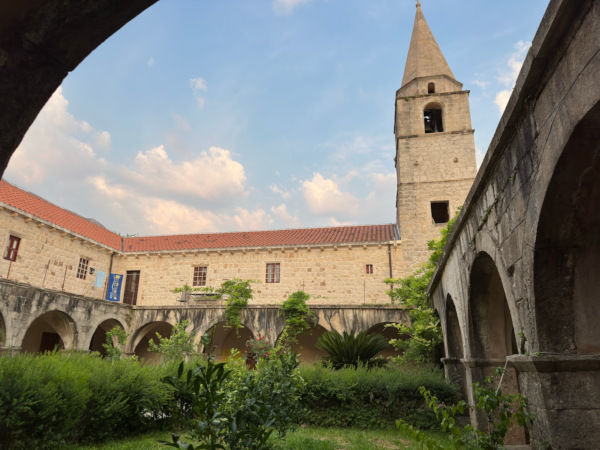
The monastery was devastated many times: it was damaged in the earthquake of 1667, burned by a Montenegrin-Russian army in 1806[8], damaged again in the 1979 earthquake, and most severely during the Homeland War in 1991, when both the church and monastery were burned. Their postwar reconstruction became, in local consciousness, a symbol of the community's own renewal.
Following population growth, from the two original parishes (Cavtat, Pločice), new parishes gradually split off between the 15th and 18th centuries: Gruda (mid-15th century), Pridvorje (1584), Mrcine/Dubravka (1731), and finally Čilipi (1731/1746).
The Franciscan Monastery of St. Blaise in Pridvorje, through its religious significance, size, and central location, in time also became an important center of cultural and political gathering for the people of Konavle. However, the other churches of Konavle also played a significant role in the everyday life of the villages. This is best illustrated by the bratovštine (confraternities), lay associations of parishioners connected to the local churches. A document from the end of the 16th century, found in the Dubrovnik archive, names as many as 61 confraternities in Konavle by name; nearly every village and hamlet had its own confraternity. Surviving matrikule (statutes) from Cavtat (1701), Gornje Mrcine (1754), and Vatasi (1755) show that the confraternities were simultaneously charitable organizations (care for the sick, burial of the poor), judicial bodies (the gastald was permitted to rule in minor disputes), and, in the words of researcher A. Marinović, genuine representatives of the rural population before the city authorities of the Republic; in other words, a kind of link between village and town[9].

In Konavle today, church spaces and the squares in front of them, besides their religious purpose, regularly serve as venues for village events, weddings, political gatherings, concerts, festivals, and folklore performances. A few of the most notable concrete examples follow. The old, preserved customs of church processions for Corpus Christi, when the squares are strewn with flowers, and the feast of St. Anthony at the monastery in Pridvorje. The folklore performance in Čilipi, on the square in front of the Church of St. Nicholas, is the longest-running and best-known cultural-tourist event in Konavle. Every Sunday from Easter to the end of October, immediately after the solemn Mass, performances by the folklore ensemble are held on the square in front of the Church. The festival of artistic and classical music, "Music and Word", regularly uses sacred spaces throughout Konavle for its programs. The Franciscan Monastery of St. Blaise in Pridvorje is one of the main cultural hubs of inland Konavle. Within the monastery complex and its church, concerts of classical and sacred music, exhibitions, and theatrical performances are held (often as part of the "Spring in Konavle" program or summer cultural evenings). A contemporary Archaeological Museum also operates there, presenting visitors with the region's rich local history. Some churches have permanent cultural displays that go beyond a purely religious function. In Cavtat, within the Church of St. Nicholas, there is a rich Painting Collection (Pinacoteca) that attracts art lovers.
In summary, besides still actively carrying out their religious functions, the churches of Konavle are living witnesses to the history of this region: from early Christianity in Cavtat, the pre-Romanesque remains in Gabrili, the stećci near Dubravka and elsewhere, the political-cultural role of the Franciscan monastery in Pridvorje, the gradual spread of parishes following settlement, to the confraternities as the fabric of village self-governance, and the contemporary cultural events connected with the churches, which represent a key fusion of tradition, culture, art, and tourism.
----------------
[1] Kapetanić, N., Vekarić, N. 1998. Stanovništvo Konavala [The Population of Konavle]. Zavod za povijesne znanosti HAZU Dubrovnik. Dubrovnik. Pp. 43-45.
[2] Ibid, pp. 36-45.
[3] Žeravica, Z. 2004. Ranosrednjovjekovna kamena tranzena na crkvi Sv. Pavla u selu Palje Brdo u Konavlima [The early medieval stone tranzena on the Church of St. Paul in the village of Palje Brdo in Konavle]. Prilozi Instituta za arheologiju u Zagrebu, Vol. 21. Zagreb. Pg. 129.
[4] Žeravica, Z. 2009. Konavle – križevi kao simbol kršćanstva na srednjovjekovnim kamenim nadgrobnim spomenicima – mramorima [Konavle – crosses as a symbol of Christianity on medieval stone gravestones – mramori]. Vjesnik Arheološkog muzeja u Zagrebu. Vol. 42. No. 1. Pg. 444.
[5] Fisković, I. 1998. Pogled na crkvene spomenike iz srednjeg vijeka u Konavlima [A look at medieval church monuments in Konavle]. Konavle u prošlosti, sadašnjosti i budućnosti, Vol. 1. Dubrovnik. Pp. 266-271.
[6] Perkić, D. 2017. Stećci kod Crkve sv. Barbare u Dubravci, Konavle [Stećci at the Church of St. Barbara in Dubravka, Konavle]. Zbornik Dubrovačkih muzeja, No. 4. Dubrovnik. Pg. 69.
[7] Ibid, pp. 67-138.
[8] Badurina, A. 1996. Franjevački samostan u Pridvorju [The Franciscan Monastery in Pridvorje]. Radovi Instituta za povijest umjetnosti, Vol. 20. Pp. 123-133.
[9] Marinović, A. 1998. Bratstva u Konavlima – lokalni organi vlasti za doba Dubrovačke Republike [Confraternities in Konavle – local organs of authority during the era of the Republic of Dubrovnik]. Konavle u prošlosti, sadašnjosti i budućnosti, Vol. 1. Dubrovnik. Pg. 111.


