

Simple stringed instruments in Konavle - for dancing and storytelling
The lijerica and gusle are traditional bowed instruments that play an important role in the musical culture and historical memory of the Croatian people. Their use and meaning differ depending on the area in which they developed. Both instruments testify to the connection between music, history and everyday life.

It is important to point out that stringed instruments as we know today were not known in ancient Greece and the Roman Empire, but their appearance is associated with the Middle Ages. Then, under the influence of Eastern traditions, they gradually became accepted and adapted in various European environments.
The lijerica is associated with the Mediterranean cultural space. In Croatia, it is found in southern Dalmatia, the Dubrovnik coast, in Konavle and on the islands of Mljet and Hvar. The oldest known example of the lijerica, which is kept in the Ethnographic Museum in Zagreb, dates back to 1820 and was made on the island of Hvar.
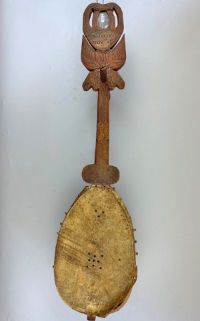
The gusle is linked to a wider Eurasian traditional layer, most pronounced in our country in the Dinaric region. The oldest records of the gusle in our area date back to the 15th century. The gusle is made from a single piece of wood. The body is hollowed out to resemble a bowl over which a tanned goatskin is stretched, which acts as a cover. It has a long, straight neck, at the top of which there is most often a depiction of the owner or a hero. Animal depictions on the neck of the gusle are not as common in Konavle as in other Dinaric regions. Konavle gusle often have a snake-shaped bow with horsehair stretched over it.
The gusle is a single-stringed, rarely double-stringed, traditional musical instrument with a bow, and is characteristic of the Dinaric region of Croatia, including Lika and Dalmatia, Bosnia and Herzegovina, Montenegro and Serbia. The basic function of the gusle is to accompany epic singing. The gusle player plays and at the same time transmits oral tradition. Therefore, the gusle has a pronounced narrative and memory role in preserving historical and mythical content.

Unlike the gusle, the lijerica has a wooden resonant body without a leather cover, and a short neck on which three strings are stretched. There are one or two sound holes on the body of the instrument under the strings. The lijerica we know today is related to the medieval lyres of the Mediterranean area. In a broader context, this instrument can be traced throughout the entire Byzantine cultural circle.

Unlike the gusle, the lijerica is most often used in dance and secular practice, especially as an accompaniment to traditional dances, such as the Lindo. Thus, it fulfills an entertaining and social function. In modern context, the lijerica also appears in artistic reconstructions of medieval music. The Croatian musicologist and world-renowned singer Katarina Livjanić, as part of the Judita artistic project, based on the text of the same name by Marko Marulić, reconstructed the musical layer of the work, relying on Gregorian and Glagolitic sources of medieval Dalmatia. In her reconstructions, the lijerica is one of the instruments used. This further confirms the historical, aesthetic and cultural value of the lijerica within Croatian musical heritage.
In musical terms, the gusle produces a monotonous and rhythmically emphasized sound that supports spoken text, while the lijerica enables a more melodic and diverse musical expression. While the gusle is a symbol of oral epic and historical memory, the lijerica is an instrument of dance and social tradition, which confirms the diversity and richness of the traditional musical heritage of Croatia and the wider South Slavic region.


