

Baltazar Bogišić Collection in Rector's Palace in Cavtat
- nikolaradonich
- 2 days ago
- 4 min read
Updated: 2 days ago
In the heart of Cavtat, immediately next to the remains of the Dubrovnik fortifications and beside the parish church of St. Nicholas, stands the Rector’s Palace of Cavtat. It was originally the residence of a Cavtat captain and served as the military, administrative, and governmental center of Cavtat during the period of the Dubrovnik Republic. Today, it houses the largest personal collection in the region – the Baltazar Bogišić Collection.
Until the arrival of Dubrovnik’s rule in Konavle in the 15th century, Cavtat was neither particularly organised nor densely populated. On the ruins of the ancient city of Epidaurum, Dubrovnik authorities began organizing life from 1427 onwards, and in 1471 they constructed fortifications so that Cavtat could serve as a refuge for the population of western Konavle in times of enemy threat.
Initially, only the military garrison with its captain resided in Cavtat, and the newly established Cavtat captaincy was subordinate to the Konavle rectory, which was headquartered in Pridvorje. In 1497 it was separated from the Konavle rectory, and from that point on, Cavtat, Močići, and Uskoplje were administered from Cavtat. Thus, the captain’s residence evolved into the Cavtat Rector’s Palace, which functioned in that role until 1808.
The construction of this Renaissance building took place between 1556 and 1558, in the spirit of typical Dubrovnik architecture, sparing no expense. It was built as a single-story structure with a high attic, a monumental façade, and a gabled roof. The palace is oriented west–east, with the entrance on the western side through a garden or promenade. Austrian architectural plans reveal the building’s former use: the ground floor was reserved for utilitarian spaces such as the kitchen, prison, and cistern, while the first floor followed the typical Dubrovnik residential layout, with a large central hall (saloča) and four rooms arranged around it.

After the fall of the Republic in 1808, the Palace was adapted to the systems of the French and the Austrian administrations. It served as an administrative building, municipal offices, a court, customs office, school, and even a warehouse. Only in 1958, following restoration works, did the building reopen as a public space under the administration of the Croatian Academy of Sciences and Arts. The goal of the restoration was to house the Baltazar Bogišić Collection, which since then has been located in the Rector’s Palace.

The small town of Cavtat has produced great individuals, among them Baltazar (Baldo) Bogišić (20 December 1834 – 24 April 1908), one of the most prominent figures in Cavtat’s history. Although the Bogišić family originated from Pičete (the parish of Dubravka), Baldo himself was born in Cavtat. His grandfather Baldo moved from Pičete to Cavtat in 1802, where the family engaged in trade and maritime activities. Baldo studied in Venice and continued his education at European universities, where he earned doctorates in philosophy and law. He authored the modern Civil Code of Montenegro and served there as Minister of Justice. In addition to being one of the leading legal scholars of his time, he was also a passionate collector and bibliophile.

Bogišić’s sister, Marija Bogišić Pohl, who managed her brother’s legacy, found after his death a collection comprised of 35,000 objects, demonstrating the seriousness of his collecting interests. She described herself as being “ready to do everything for the benefit and progress of her Cavtat,” and used funds from her brother’s estate for public purposes. She is still remembered in Cavtat as a benefactress. Above all, she considered the preservation of the collection to be of the utmost importance and insisted that it must remain in Cavtat.
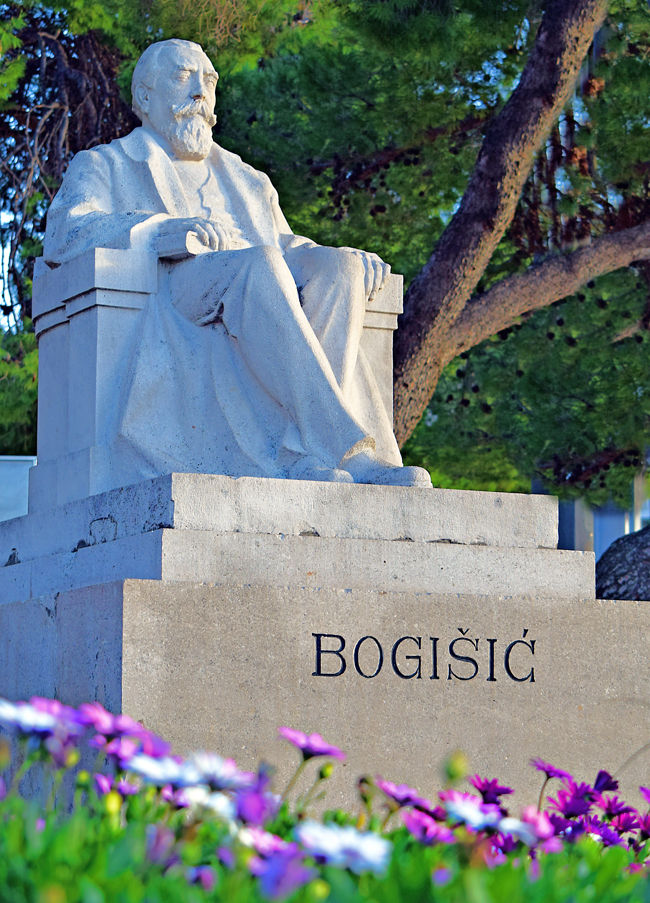
The Bogišić family owned two houses in Cavtat, both located in close proximity to the Rector’s Palace, one to the northwest and one to the southwest. Baldo Bogišić was born in one of these houses. The one to the southwest was attached to the old town gate, which the municipal authorities decided to demolish. Marija Pohl consented and agreed to give the house to the municipality for demolition. The authorities expanded the waterfront at that location and decided to erect a monument to Baltazar Bogišić there.

The Baltazar Bogišić Collection consists of a large numismatic collection assembled by Bogišić himself, collections of weapons and ethnographic objects, an archaeological collection gathered by the Epidaurum Society, a library containing incunabula, manuscripts, and maps, as well as a valuable collection of approximately 8,000 prints dating from the 16th to the 19th century. Alongside the artefacts, Bogišić’s personal archive is of immense importance—his correspondence represents an inexhaustible source for research into the social dynamics of his time.
Marija Bogišić Pohl’s initiative to establish the collection was truly the first museological concept in Konavle. At that time, the only museum in the Dubrovnik area was the National Museum housed in the Rector’s Palace in Dubrovnik. In his will, Bogišić designated the Academy of Sciences and Arts as the heir to his scholarly material; the Academy remains the owner of the collection and property to this day. Nevertheless, thanks to Marija Pohl, the collection was preserved in Cavtat. The Academy allowed the memorial collection, which had been kept in Bogišić’s birthhouse from 1909 to 1958, to be relocated due to inadequate spatial and conservation conditions. In the late 1950s it was transferred to the Cavtat Rector’s Palace, where a permanent exhibition was installed in the early 1960s.
With this collection, Cavtat and its Rector’s Palace have assumed an important place on Croatia’s heritage map. Thanks to the high urban planning standards of the Dubrovnik Republic, Baltazar Bogišić’s lifelong dedication to science and heritage, the philanthropy of Marija Bogišić Pohl, and the vision of conservator Cvito Fisković and his contemporaries in the 1950s, Cavtat today possesses a valuable center for the research and presentation of cultural heritage. The collection is currently not open to visitors.


